Betting Exchange Dynamics: How Betfair and Similar Platforms Structure Their Promotional Offers Differently from Fixed-Odds Bookmakers
Drew Roth · Aug 23, 2026

Betting Exchange Dynamics: How Betfair and Similar Platforms Structure Their Promotional Offers Differently from Fixed-Odds Bookmakers
Core Mechanics of Betting Exchanges
Betting exchanges function as peer-to-peer marketplaces where participants place opposing wagers directly against one another, and the platform collects a commission on net profits rather than building margins into quoted odds. This model allows odds to reflect real-time supply and demand among users, whereas fixed-odds bookmakers set prices in advance and adjust them based on liability management. Researchers at the University of Nevada Reno have documented how these structural distinctions shape every aspect of promotional design, from bonus mechanics to eligibility rules.
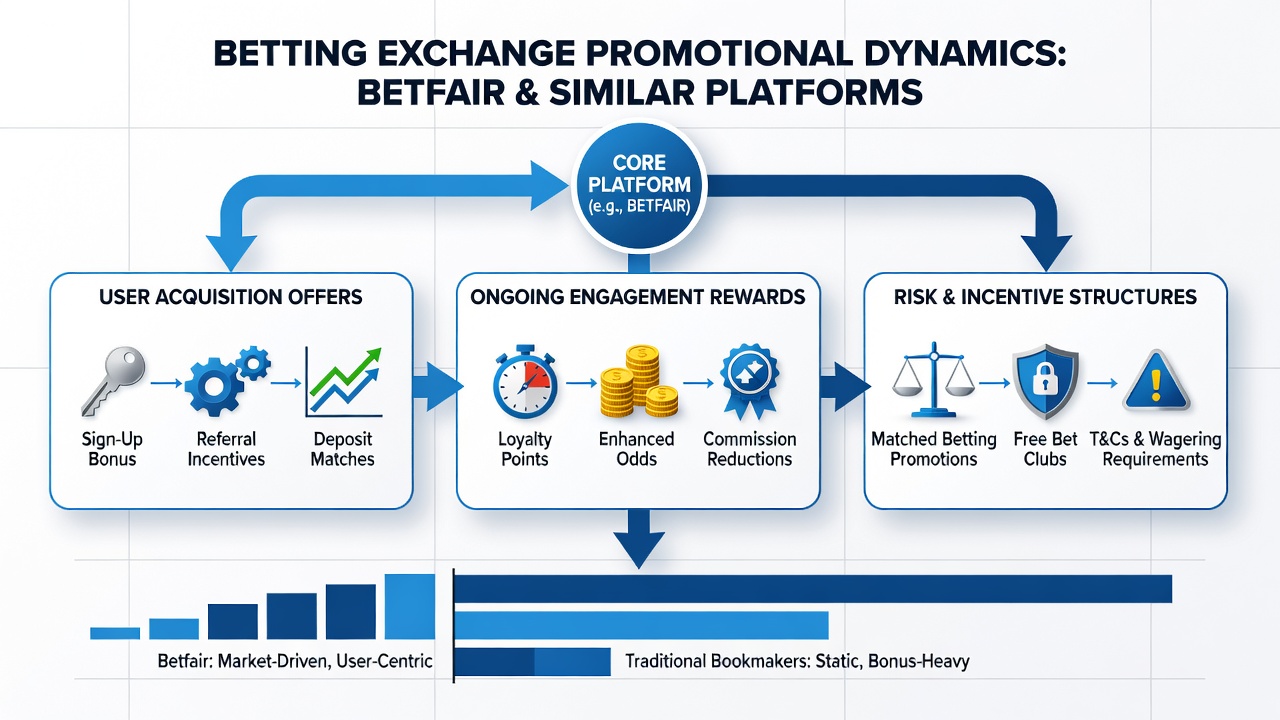
Operators such as Betfair charge commission rates that typically range between two and five percent depending on the market and user volume, and promotional offers often target reductions in those fees or cashback on losing periods. Fixed-odds sites, by contrast, structure rewards around stake multipliers, free bet credits, and enhanced price boosts that compensate for the built-in overround in their odds.
Promotional Structures on Major Exchanges
Betfair and comparable platforms release offers that emphasize commission-free periods on selected events or loyalty schemes that rebate a portion of fees after a threshold of activity. These incentives align directly with the exchange model because they lower the cost of participation without altering the fundamental odds that users create. Data from the Australian Communications and Media Authority shows that commission-focused promotions generate higher retention rates among experienced bettors who already understand market dynamics.
Deposit bonuses on exchanges frequently convert into betting credits that still incur standard commission once deployed, creating a two-step reward process. Users must first place qualifying wagers, after which any net profit attracts the usual fee unless a specific promotion waives it. This layered approach differs markedly from fixed-odds campaigns that deliver immediate stake returns or risk-free bets where losses are refunded in full.
Fixed-Odds Bookmaker Reward Models
Traditional operators allocate marketing budgets toward price enhancements that temporarily reduce their margin on popular selections, accumulator boosts that multiply returns on multi-leg bets, and sign-up packages that match initial deposits with bonus funds subject to wagering requirements. These tools offset the disadvantage of static odds by providing extra value at the point of entry or during peak events.
Liability control remains central because bookmakers must balance exposure across both sides of a market. Promotions therefore include caps on maximum stakes or exclusions for certain high-volume users, measures that exchanges rarely apply since risk transfers directly between participants.
Regulatory and Market Context in August 2026
By August 2026 several jurisdictions had introduced updated advertising codes that require clearer disclosure of commission rates on exchange platforms and tighter rules around bonus expiration. Industry reports from the European Gaming and Betting Association indicate that these changes prompted exchanges to simplify their terms while fixed-odds operators responded with more segmented reward tiers based on user tenure and average stake size.
Cross-border operators continue to test hybrid models that combine exchange liquidity with occasional fixed-odds overlays, yet the underlying incentive structures remain distinct. Observers note that markets with mature exchange penetration, such as Australia and parts of Europe, show sustained differences in how each platform type allocates promotional spend.
Comparative Impact on User Behavior
Studies conducted by the Responsible Gambling Council in Canada reveal that exchange users respond more strongly to fee rebates and volume-based loyalty tiers, while fixed-odds customers show greater engagement with time-limited price boosts. The distinction arises because each format's core economics reward different betting patterns: exchanges favor liquidity providers who take both sides, and bookmakers favor volume on higher-margin selections.
Eligibility criteria also diverge. Exchange promotions often require minimum trade volumes measured in matched stakes, whereas fixed-odds offers tie rewards to deposit amounts or number of bets placed. These thresholds reflect the platforms' respective cost structures and risk profiles.
Conclusion
The promotional architectures of betting exchanges and fixed-odds bookmakers therefore stem directly from their operational models, with commission-based incentives dominating the former and margin-offset rewards characterizing the latter. As regulatory frameworks evolve and user preferences shift, both segments continue to refine offer mechanics while preserving these foundational differences. Data from multiple oversight bodies confirms that the two formats maintain separate appeal depending on participant experience level and preferred market engagement style.